

Client Portfolio & Partnership History
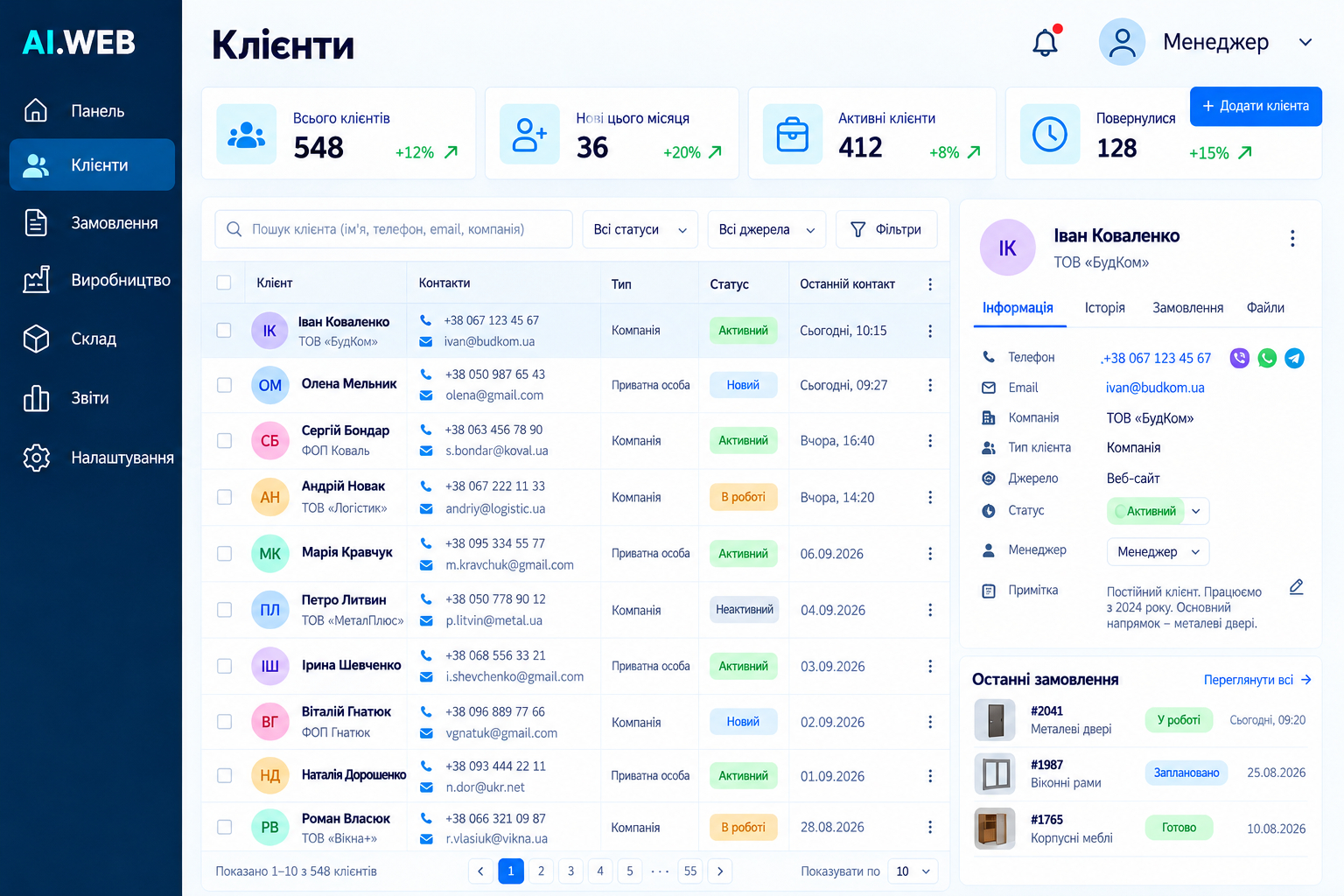
Manage customer contact information, communication history, quotes, and order records all in one convenient profile.
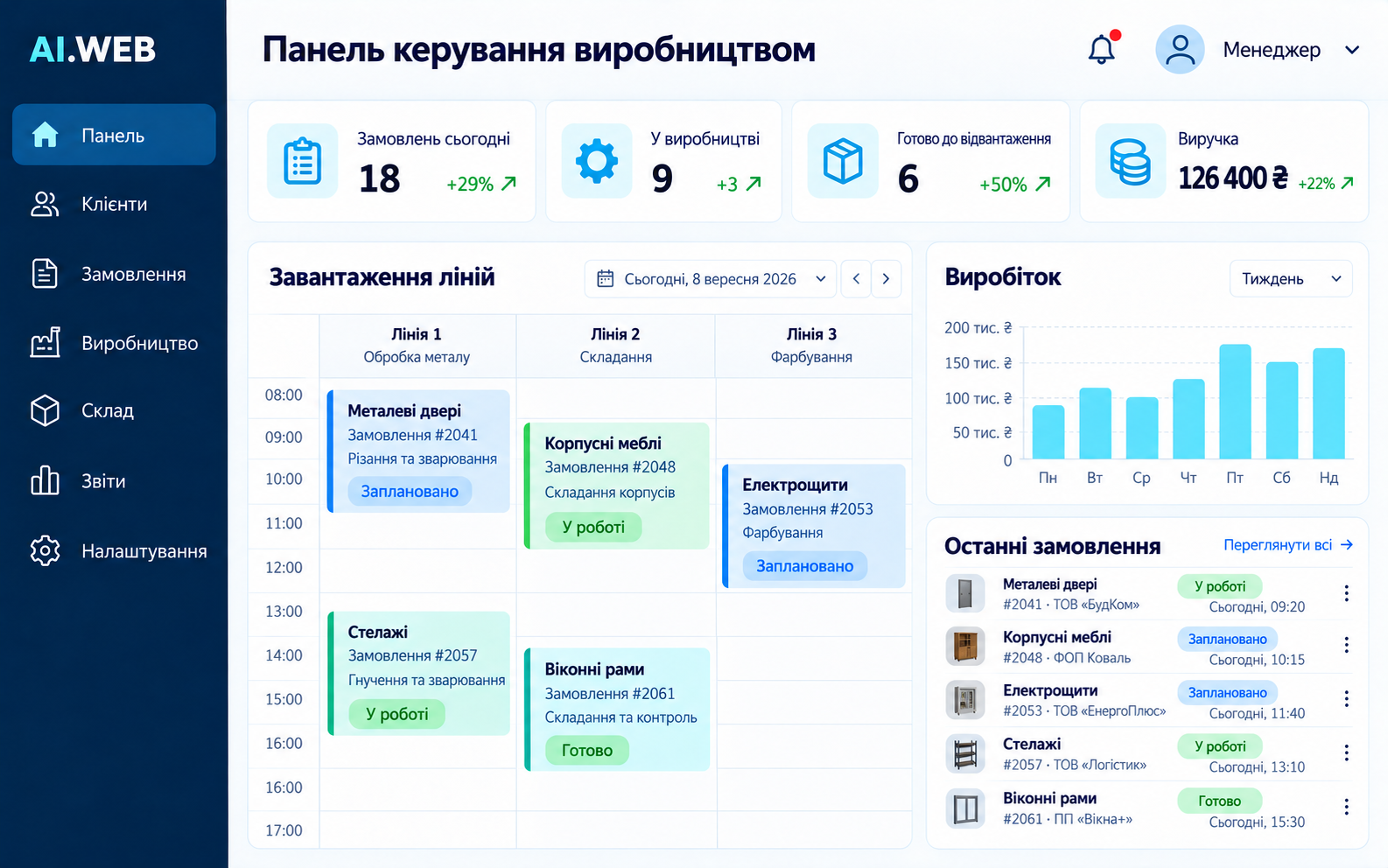
Manufacturing CRM — streamline production orders, optimize job scheduling, manage inventory in real time, and track costs with precision.
Manage customer contact information, communication history, quotes, and order records all in one convenient profile.
Manage every client interaction from initial inquiry and cost estimation through contract finalization and production launch.
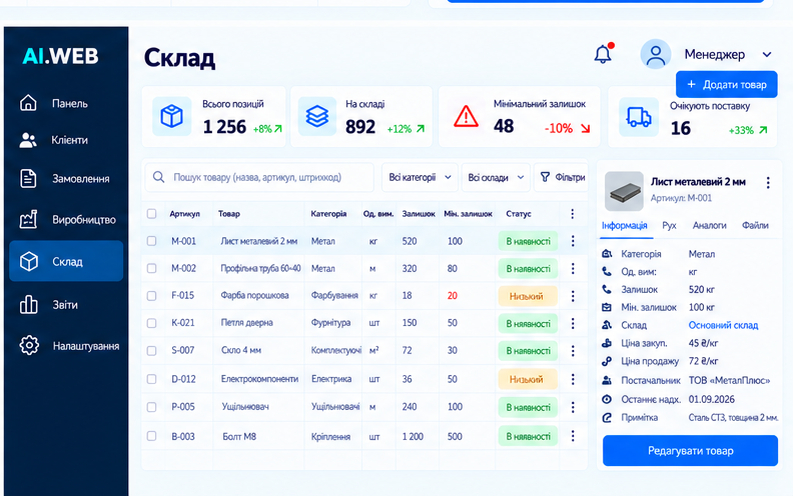
Centralized access to inventory management, stock levels, product specifications, technical requirements, compliance documentation, and delivery timelines—all in one intuitive platform.
Comprehensive cost estimation incorporating materials, labor, and project expenses, with professional proposal generation for client review.
Break down projects into sequential phases with clearly defined timelines, assigned ownership, and priority levels.
Streamline task allocation across teams and departments while monitoring resource utilization and project completion metrics.
Monitor order progress, identify delays, and stay informed about estimated completion timelines for every shipment.
Monitor prepayments, track outstanding balances, manage partial shipments, and ensure timely delivery of finished goods to your customers.
Manufacturing CRM — an enterprise management platform that consolidates customer orders, production workflows, inventory control, workforce management, and financial metrics into a unified digital workspace.
We develop custom CRM solutions for manufacturing operations of any scale, from small job shops to multi-facility enterprises with complex production processes, distributed warehousing, and intricate workflows.
Automation reduces manual data entry, ensures on-time order delivery, optimizes material allocation, and measurably improves production efficiency.
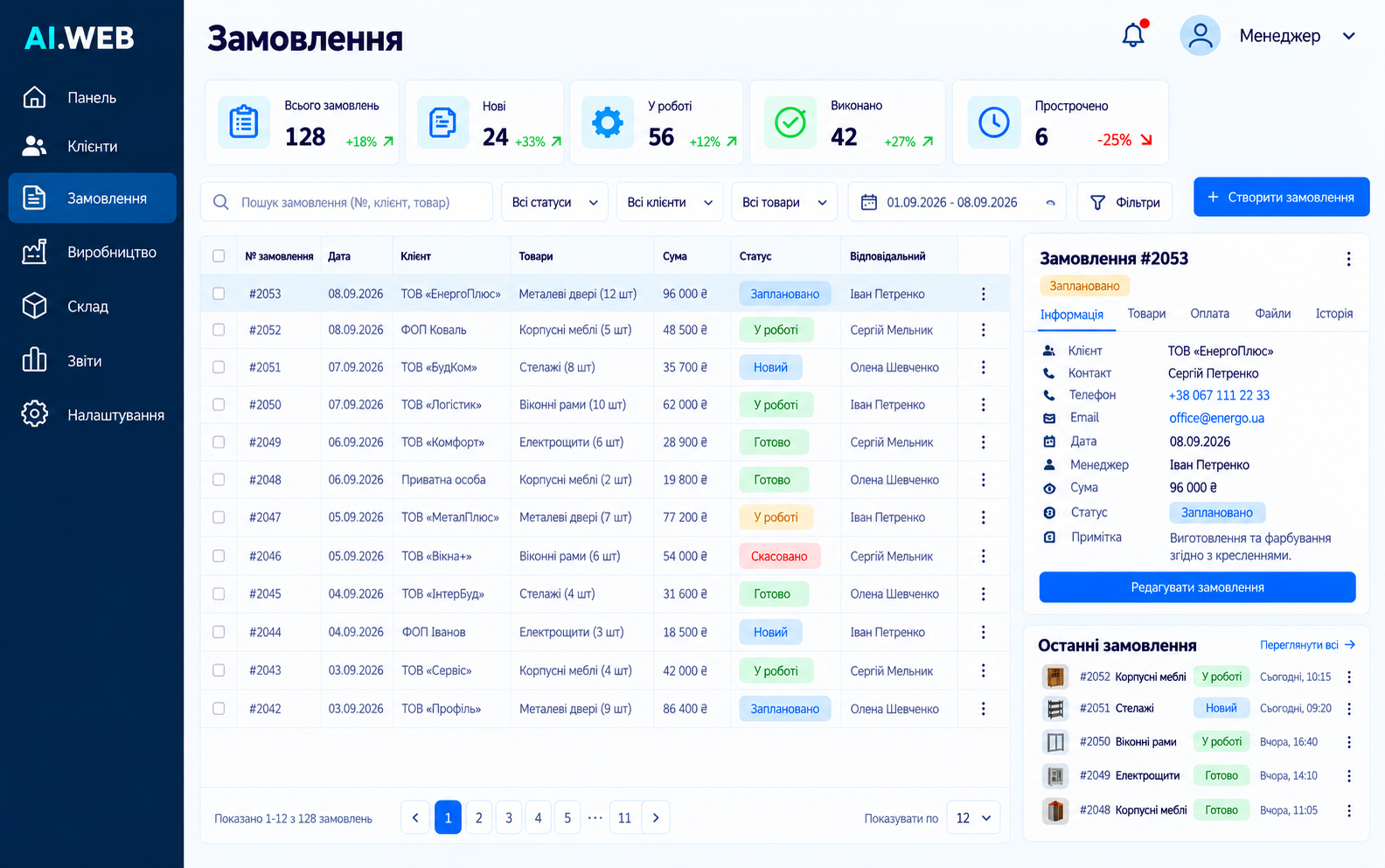
Each order progresses through defined stages: initial intake, technical specification review, production, quality assurance, and final shipment.
The CRM enables you to:
Management gets real-time visibility into each order's progress and can respond immediately to delays.
The CRM streamlines workshop scheduling, task distribution, and production plan execution.
You can build a master production calendar, prioritize orders based on deadlines, factor in equipment availability, and monitor adherence to planned timelines.
This is essential for shops managing dozens or hundreds of concurrent custom orders.
Track raw materials, components, consumables, and finished goods in real-time.
Key capabilities include:
Optionally integrate barcode scanning equipment or connect to existing warehouse management systems.
Automatically calculate both estimated and actual production costs for each product.
The system factors in material expenses, resource consumption, labor allocations, processing operations, and overhead.
This enables you to track order profitability, identify cost overruns, and establish competitive pricing.
Each team member accesses tasks appropriate to their role and permissions.
Production technicians see work orders, managers monitor customer commitments, warehouse staff track materials, and leadership gets an enterprise-wide operational view.
Optionally implement time tracking, operation logging, and piecework payroll calculations.
The system maintains a comprehensive customer record: contacts, previous orders, documentation, and communication history.
Managers quickly locate information, generate quotes, replicate prior orders, or verify current contract status.
Dashboards and reports measure operational performance:
Leadership accesses current KPIs without manual compilation from spreadsheets and paper documents.
We've built CRM platforms for diverse manufacturing verticals:
System functionality aligns with your specific operational workflows and business requirements.
Off-the-shelf CRM platforms often fall short for manufacturers. They handle sales pipelines well but lack the production control, material tracking, and capacity planning features production requires.
Custom CRM development creates a solution that mirrors your company's actual processes.
You can implement specialized modules, configure granular access permissions, build staff dashboards, integrate with your website, accounting software, warehouse equipment, and third-party services.
The system grows alongside your business.
CRM eliminates dependence on spreadsheets, paper documents, and manual data handoffs between departments.
Automation delivers greater transparency in order management, tighter resource control, instant access to production metrics, and faster problem identification and resolution.
Every project has its own requirements, so pricing and timelines vary based on your specific needs, feature set, and scope. Below are typical cost ranges for common solutions.
Final pricing is determined once we clarify your specific requirements. Paid third-party services, integrations, and custom development work are quoted separately.
We've compiled answers to your most pressing questions to help guide your decision. Can't find what you're looking for? Reach out to our team.
Ask Your QuestionHere's how it works: AI-WEB provides a proprietary CRM platform that we customize to fit your business needs. We configure modules, data fields, workflow statuses, user roles, and reporting dashboards to match your operations. Should your processes require additional functionality, we'll evaluate custom development and third-party integrations separately.
We establish your initial CRM setup by mapping core business processes around customer management, communication workflows, orders, and team responsibilities. Together, we'll define what data to capture, clarify ownership of lead handling, and outline your order fulfillment pipeline. All agreed-upon modules, reporting dashboards, and configuration specifications are documented in the proposal before implementation begins.
Before we begin, we'll prepare a detailed proposal outlining the scope of work and payment terms. We break down CRM configuration costs separately, along with platform licensing fees, hosting, and ongoing support. Any integrations, add-on modules, and third-party services are itemized as distinct line items. All payment schedules and milestones are confirmed in our service agreement.
Data migration can be incorporated into your implementation process. We start by auditing your current system's export capabilities, including field structure, data completeness, and duplicate records. From there, we identify which contacts, products, orders, and other records are eligible for import, align on scope, and validate the migration results to ensure accuracy.
We offer comprehensive hosting and managed support services, with the flexibility to deploy your CRM on a dedicated server environment tailored to your needs. If you're running your own infrastructure, we'll evaluate deployment feasibility based on our platform's technical specifications. Prior to implementation, we'll establish clear agreements regarding access protocols, system administration, backup procedures, and hosting fees.
Mobile functionality depends on your selected modules and specific workflow requirements. During the discovery phase, we identify key mobile use cases—such as client management, status updates, task tracking, and scheduling—to ensure your team can work efficiently on the go. We validate these scenarios through demonstrations and confirm any necessary interface adjustments. If a dedicated mobile app is required, we'll provide a separate assessment and cost estimate.
Support scope is defined through your service agreement and can encompass system health monitoring, technical troubleshooting and issue resolution, data backup and recovery, and ongoing system guidance. We provide comprehensive user training during implementation. Additional features, process modifications, and custom integrations are evaluated separately and quoted outside your standard maintenance plan.
AI-WEB delivers a proprietary CRM platform built for scalability, paired with comprehensive implementation and customization services. We start by mapping your existing workflows—how leads flow through your pipeline, who owns each stage, and what metrics matter to your leadership team. From there, we configure modules, fields, custom statuses, and granular permission sets to match your operations. Complex requirements and third-party integrations are scoped separately, with deployment and ongoing technical support available through a single dedicated team.
Start by setting up your client database, leads, and tasks—get comfortable with the core functionality first. Once your team is up to speed, you can roll out additional modules like inventory management, document handling, financial reporting, or automated notifications. We'll sequence the implementation based on your business priorities, accounting for module dependencies and any data migration requirements.
Standard implementations typically take 2–4 weeks to complete. More complex integrations, large-scale data migrations, and custom modules may require additional time. We'll need documentation of your workflows, sample files, migration datasets, and a dedicated point of contact to streamline approvals. Final timelines are determined after we assess the full scope of your project.
Yes, provided the necessary technical infrastructure is in place. We can configure automated lead and order routing from your website, establish data synchronization with accounting software, phone systems, shipping carriers, and payment processors. Our integration process begins with API documentation review and assessment of available connection methods, followed by data mapping and flow direction analysis. Integration availability and setup costs are evaluated on a per-service basis.
During setup, we establish role-based access controls and define the specific operations each role can perform. For instance, account managers typically need visibility into their client portfolios, department heads require team oversight and performance tracking, while accounting staff need access to payment records and financial data. We configure permissions separately for sensitive areas like financial reporting, data exports, record modifications, and deletions. All access restrictions should be validated and tested before going live.
During implementation, we provide comprehensive training on your agreed-upon workflows: adding clients, processing requests, updating order status, and assigning tasks. We'll outline the training approach, documentation structure, and post-launch support in our proposal. We've found that hands-on training works best when we use real-world scenarios from your daily operations.
Ongoing expenses typically cover platform subscription fees based on your selected plan, server hosting, technical support, and third-party integrations. Additional charges may apply for SMS messaging, voice services, email campaigns, and other add-on features you activate. We separate implementation costs from recurring fees upfront, clearly outline billing cycles, and explain what factors influence your total investment.
Establish clear data ownership, usage rights, and retrieval protocols in your service agreement before implementing CRM. Address key considerations upfront: determine who has system access, define which datasets can be exported, specify file formats, and set timelines for data transfers. If you're planning to migrate to a different platform later, let us know during the initial consultation—we'll assess export capabilities and develop a structured data handoff process.
As part of our technical support services, we can establish regular automated backups and data recovery protocols. We'll work with you to determine the backup frequency, storage location, and retrieval procedures based on your CRM hosting environment. Data exports can be customized to your needs—we'll identify the specific modules, fields, and file formats required for your workflow. Keep in mind that system backups and data migration files serve different purposes and are managed accordingly.
No results found for your search. Try different keywords or select "All Questions" to browse our complete resource library.
Tell us about your idea or task — we will propose the best solution and action plan.
 We will discuss your task
 Convenient communication
 Transparent proposal
 Attention to your needs
 Want to discuss it now?Our contacts
Describe your task and leave a contact for our reply.
© 2026 ai-web.com.ua. All Rights Reserved.

