

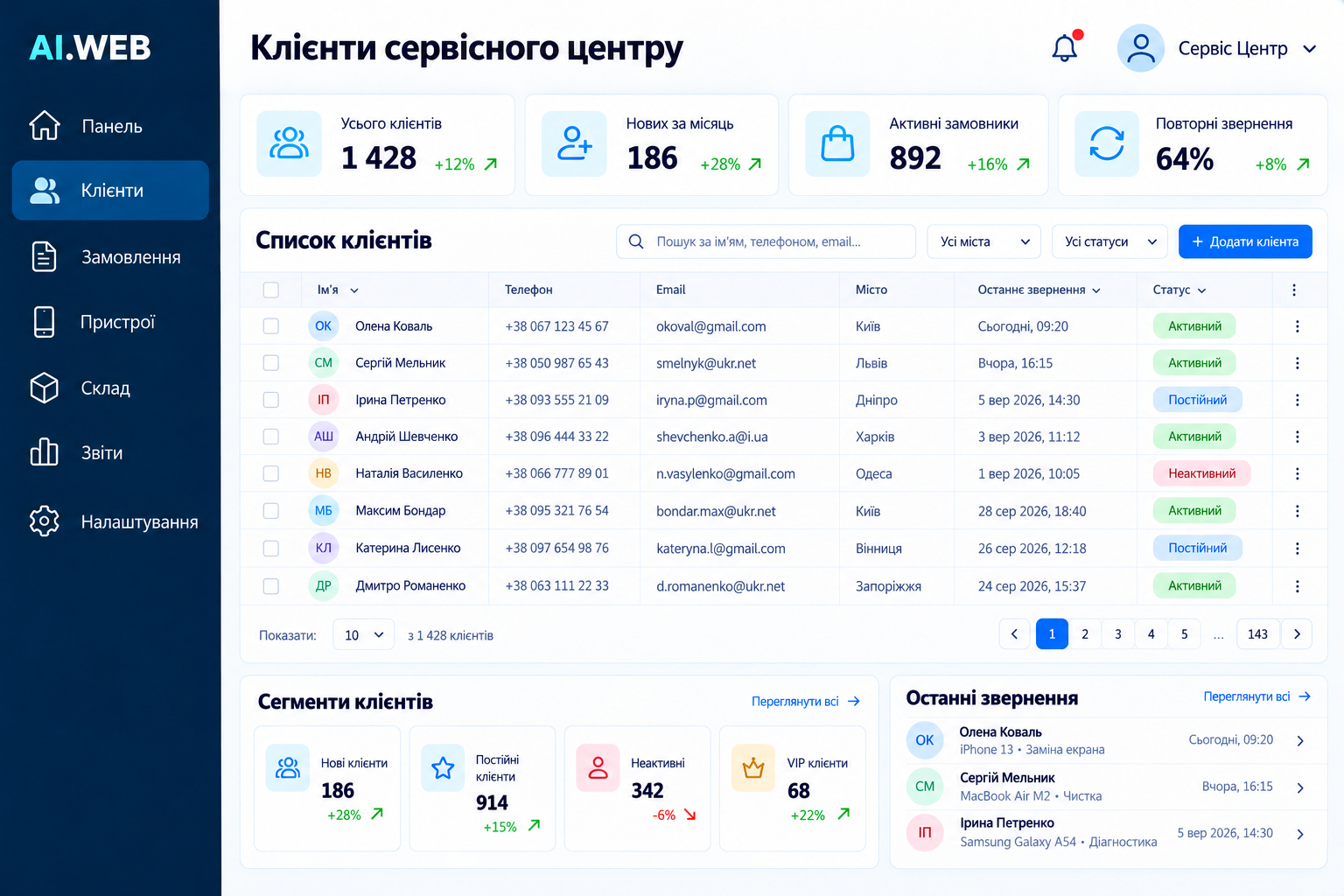
Client Management & Support History
Manage client contact information, service history, past repairs, and communication records all in one convenient location.
Streamline your service center operations with a CRM built to handle your repair business. Manage work orders, track technician productivity, maintain inventory control, and keep complete service histories all in one integrated platform.
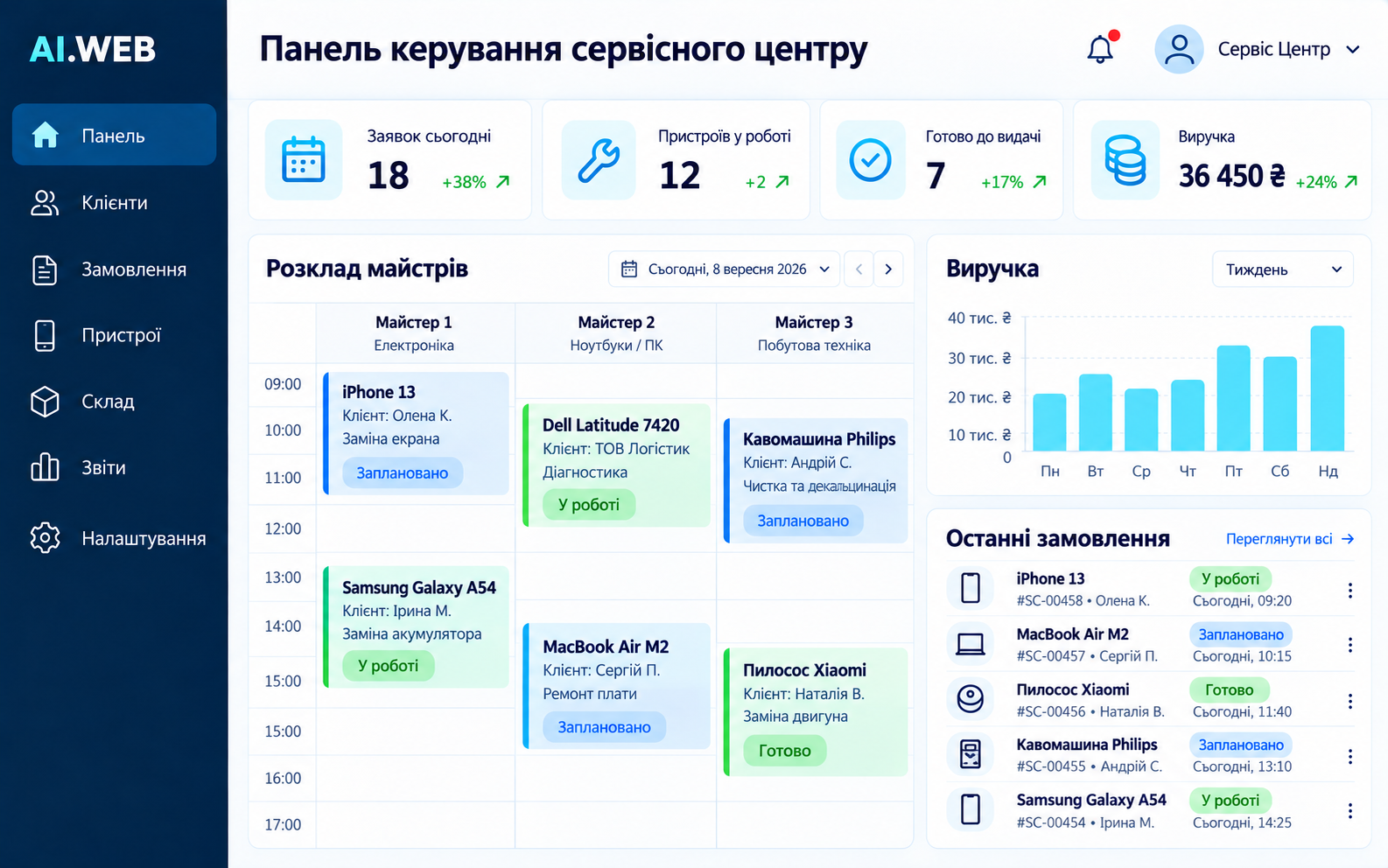
Manage client contact information, service history, past repairs, and communication records all in one convenient location.
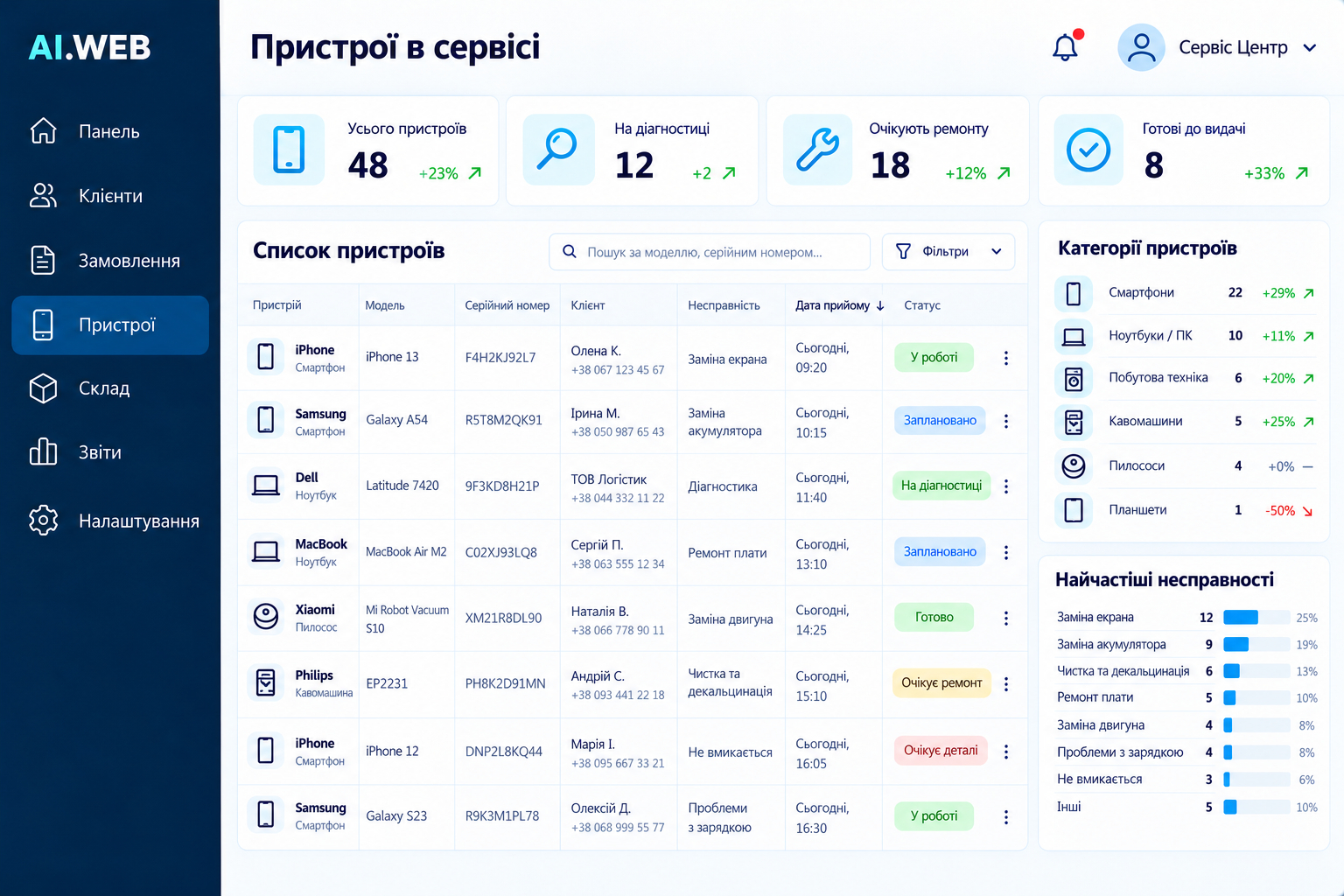
We document the device model, serial number, included components, physical condition, and reported malfunction to establish a baseline for your repair.
Complete service history at your fingertips—equipment details, diagnostic findings, work performed, parts used, and assigned technician all in one work order.
Real-time service tracking from intake and diagnostics through parts procurement, repair completion, and customer pickup.
We'll prepare a detailed estimate, lock in your approval, and adjust pricing if our diagnostic reveals additional work.
Intelligent order assignment to technicians based on their expertise, current workload, and project timelines.
Manage inventory levels, reserve components for upcoming orders, and track consumption of parts and materials.
Track prepayments, partial and full payments, and monitor outstanding balances for every order in real time.
Service Center Management Software — a comprehensive platform for managing repair jobs, customer relationships, technician assignments, parts inventory, and financial operations. It streamlines every phase of service delivery, from intake through diagnostics, repair completion, and customer handoff.
We develop custom CRM solutions tailored to your service center's unique workflow. Automate daily operations, reduce ticket processing time, and consistently deliver quality service that keeps customers coming back.
Our platform adapts to virtually any repair and maintenance specialty:
Whether you're a solo technician or a multi-location operation, the system consolidates all workflows into one digital workspace.
Every customer request flows into a centralized system. Managers create tickets, document issues, categorize equipment type, assign technicians, and set realistic turnaround estimates.
The platform ensures no incoming request slips through the cracks and provides clear visibility into workload distribution across your team.
The system maintains complete customer profiles including contact information, equipment details, previous repairs, warranty coverage, and communication logs.
When a customer calls back, your team instantly retrieves relevant history and can recommend appropriate solutions without repeating data collection.
Each job moves through defined stages: intake, diagnosis, estimate approval, repair execution, testing, and delivery.
Managers view real-time job status, assigned technician, due dates, and required parts at a glance.
Handle dozens of concurrent repairs seamlessly—no more paper logs or spreadsheet chaos.
Monitor component availability, reserve parts for specific jobs, track usage, and manage ordering. The system automatically deducts parts as repairs complete and alerts you when stock runs low.
This reduces supply shortages and enables accurate cost calculation for each repair.
Distribute work orders, set priorities, monitor completion rates, and measure individual productivity.
Management gains transparency into completed repairs, technician utilization, and potential bottlenecks.
Track payments, labor costs, parts expenses, and overall service center profitability.
Detailed reports reveal your most profitable services, operational efficiency metrics, and support data-driven business decisions.
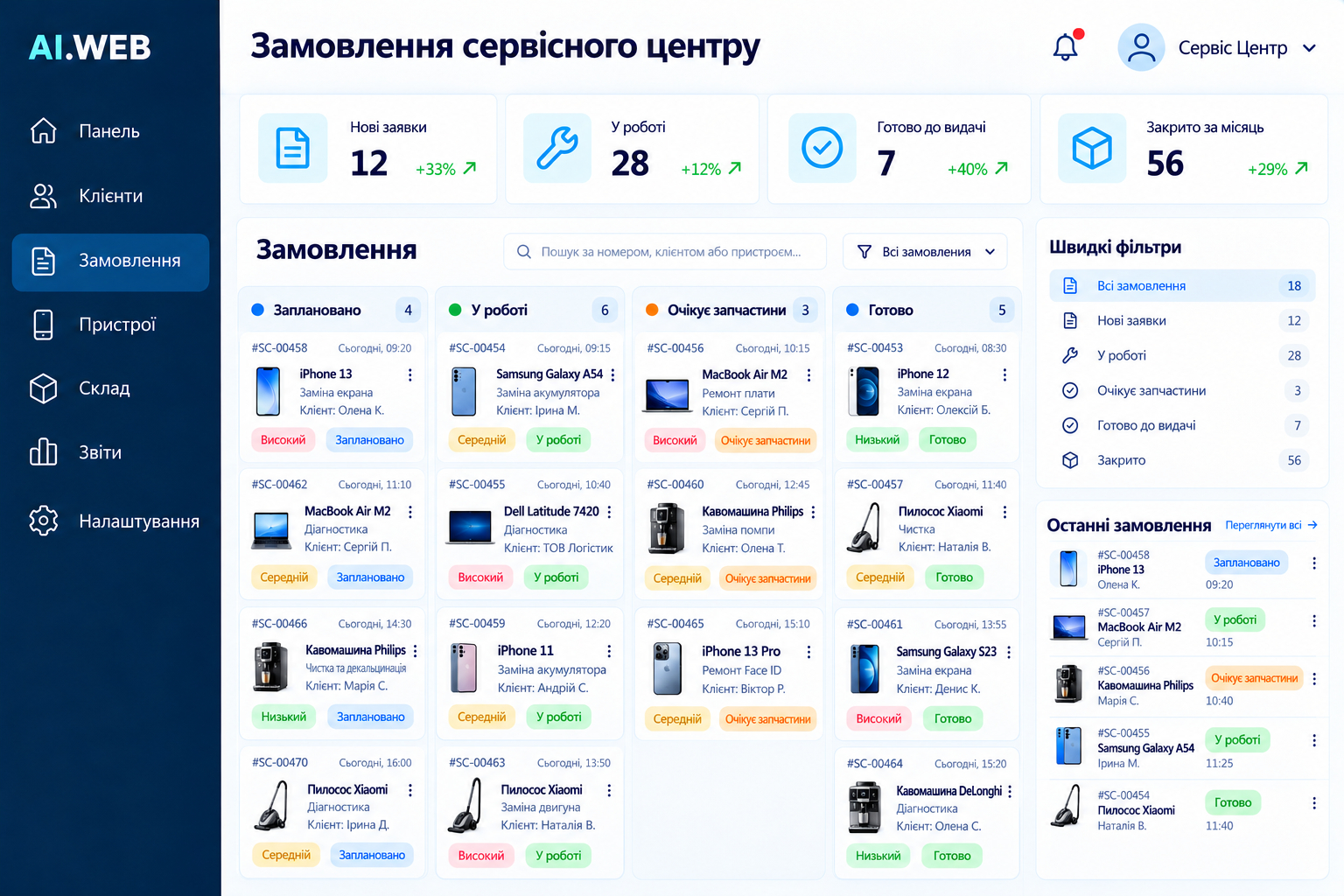
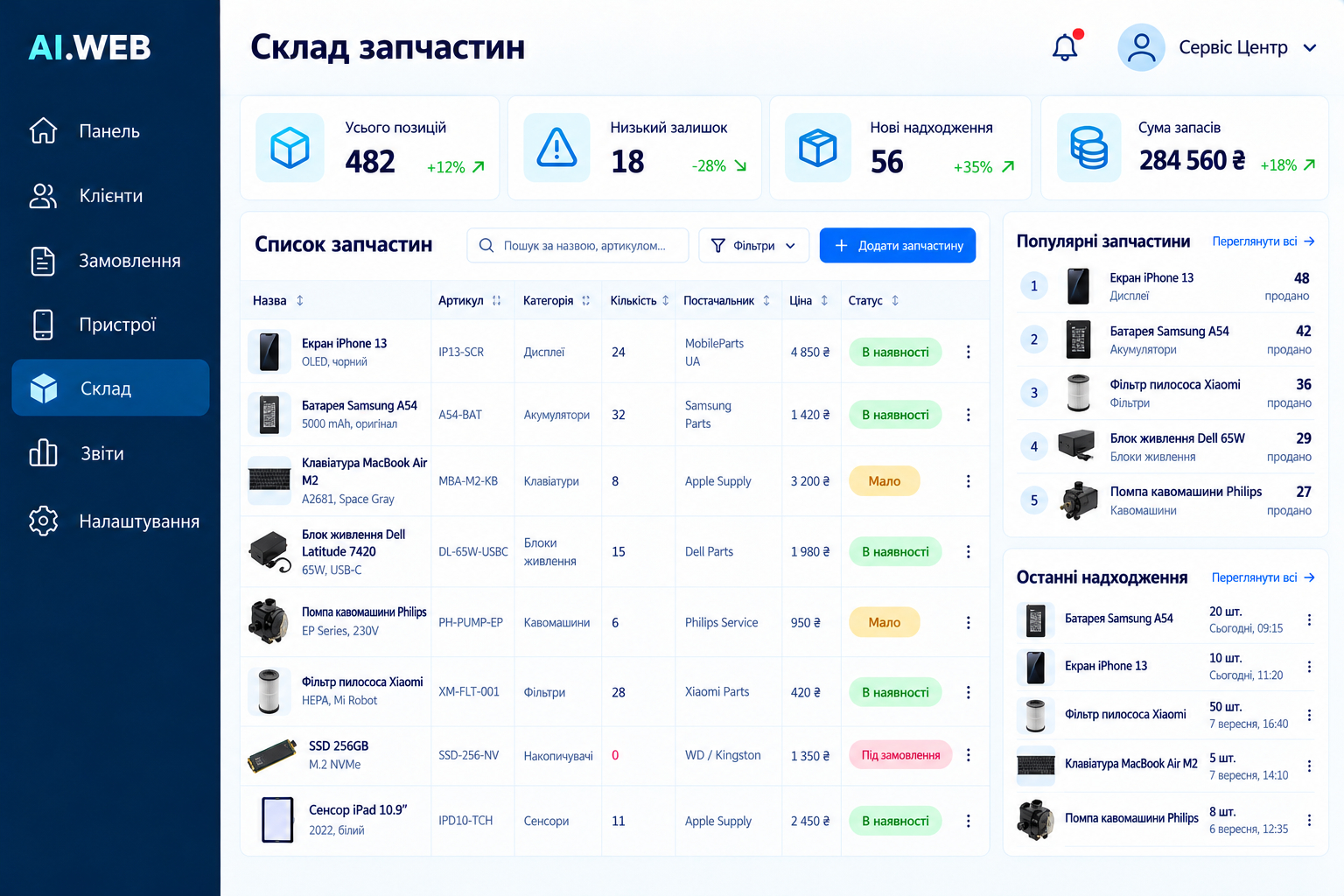
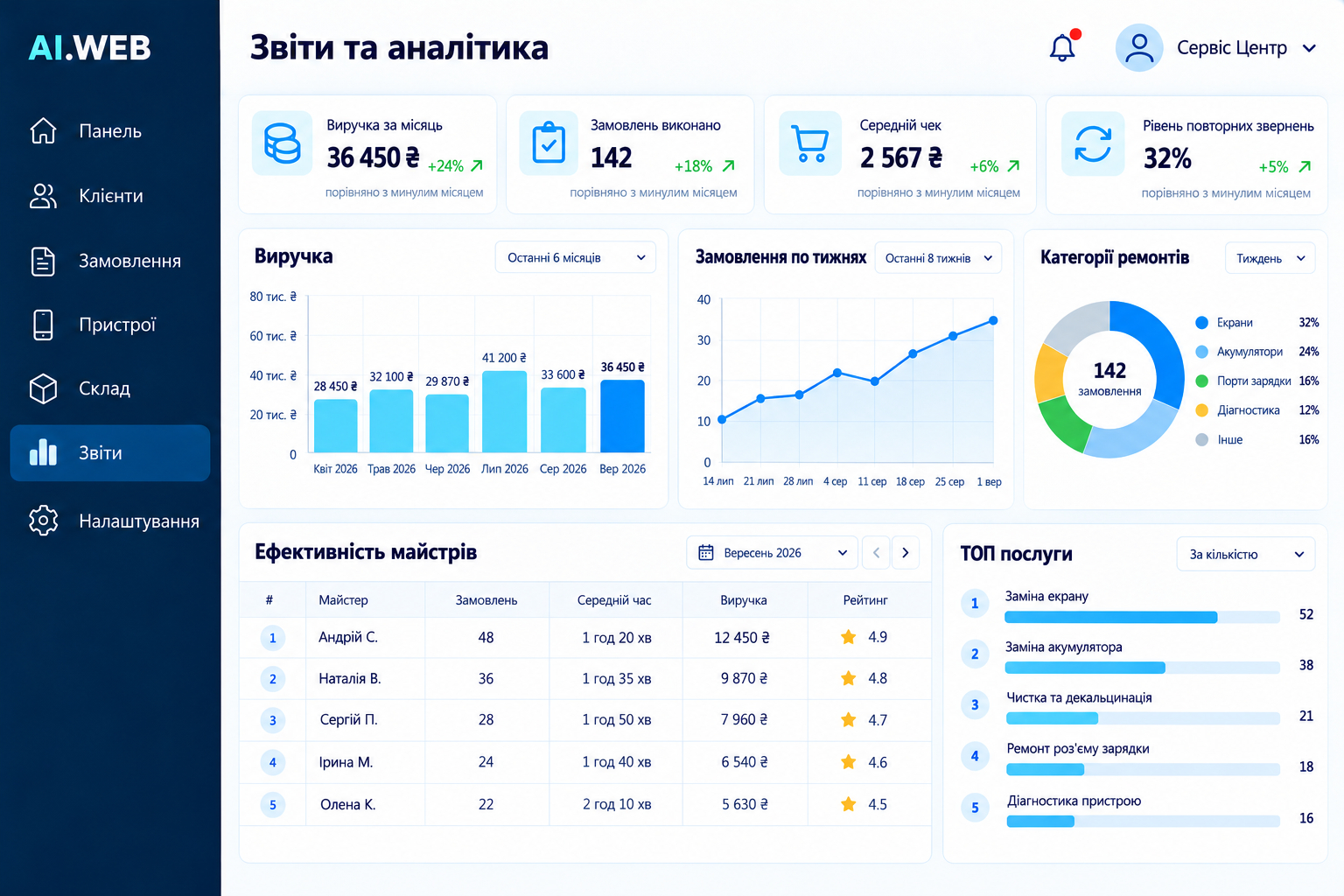
Every transaction is logged, giving management complete visibility into the service lifecycle.
Eliminate Manual Overhead. Automation handles ticket creation, document generation, and status updates, freeing your team from administrative tasks.
Transparent Operations Control. Leadership sees exactly which jobs are in progress, which are waiting on parts, and which need immediate attention.
Elevated Customer Experience. Instant access to repair history and proactive status updates build trust and loyalty.
Smarter Inventory Planning. Real-time parts data and usage tracking enable efficient purchasing and reduce waste.
Built for Growth. Scale seamlessly by adding technicians, locations, and features as your business expands.
Generic repair software rarely aligns perfectly with actual business operations. Some centers need simple ticket management; others require complex multi-location solutions with warranty tracking, integrations, and sophisticated reporting.
We build CRM systems around your specific requirements. Depending on your needs, we can implement:
We analyze your existing processes and build only the features that directly support your daily operations.
Every project has its own requirements, so pricing and timelines vary based on your specific needs, feature set, and scope. Below are typical cost ranges for common solutions.
Final pricing is determined once we clarify your specific requirements. Paid third-party services, integrations, and custom development work are quoted separately.
We've compiled answers to your most pressing questions to help guide your decision. Can't find what you're looking for? Reach out to our team.
Ask Your QuestionHere's how it works: AI-WEB provides a proprietary CRM platform that we customize to fit your business needs. We configure modules, data fields, workflow statuses, user roles, and reporting dashboards to match your operations. Should your processes require additional functionality, we'll evaluate custom development and third-party integrations separately.
We establish your initial CRM setup by mapping core business processes around customer management, communication workflows, orders, and team responsibilities. Together, we'll define what data to capture, clarify ownership of lead handling, and outline your order fulfillment pipeline. All agreed-upon modules, reporting dashboards, and configuration specifications are documented in the proposal before implementation begins.
Before we begin, we'll prepare a detailed proposal outlining the scope of work and payment terms. We break down CRM configuration costs separately, along with platform licensing fees, hosting, and ongoing support. Any integrations, add-on modules, and third-party services are itemized as distinct line items. All payment schedules and milestones are confirmed in our service agreement.
Data migration can be incorporated into your implementation process. We start by auditing your current system's export capabilities, including field structure, data completeness, and duplicate records. From there, we identify which contacts, products, orders, and other records are eligible for import, align on scope, and validate the migration results to ensure accuracy.
We offer comprehensive hosting and managed support services, with the flexibility to deploy your CRM on a dedicated server environment tailored to your needs. If you're running your own infrastructure, we'll evaluate deployment feasibility based on our platform's technical specifications. Prior to implementation, we'll establish clear agreements regarding access protocols, system administration, backup procedures, and hosting fees.
Mobile functionality depends on your selected modules and specific workflow requirements. During the discovery phase, we identify key mobile use cases—such as client management, status updates, task tracking, and scheduling—to ensure your team can work efficiently on the go. We validate these scenarios through demonstrations and confirm any necessary interface adjustments. If a dedicated mobile app is required, we'll provide a separate assessment and cost estimate.
Support scope is defined through your service agreement and can encompass system health monitoring, technical troubleshooting and issue resolution, data backup and recovery, and ongoing system guidance. We provide comprehensive user training during implementation. Additional features, process modifications, and custom integrations are evaluated separately and quoted outside your standard maintenance plan.
AI-WEB delivers a proprietary CRM platform built for scalability, paired with comprehensive implementation and customization services. We start by mapping your existing workflows—how leads flow through your pipeline, who owns each stage, and what metrics matter to your leadership team. From there, we configure modules, fields, custom statuses, and granular permission sets to match your operations. Complex requirements and third-party integrations are scoped separately, with deployment and ongoing technical support available through a single dedicated team.
Start by setting up your client database, leads, and tasks—get comfortable with the core functionality first. Once your team is up to speed, you can roll out additional modules like inventory management, document handling, financial reporting, or automated notifications. We'll sequence the implementation based on your business priorities, accounting for module dependencies and any data migration requirements.
Standard implementations typically take 2–4 weeks to complete. More complex integrations, large-scale data migrations, and custom modules may require additional time. We'll need documentation of your workflows, sample files, migration datasets, and a dedicated point of contact to streamline approvals. Final timelines are determined after we assess the full scope of your project.
Yes, provided the necessary technical infrastructure is in place. We can configure automated lead and order routing from your website, establish data synchronization with accounting software, phone systems, shipping carriers, and payment processors. Our integration process begins with API documentation review and assessment of available connection methods, followed by data mapping and flow direction analysis. Integration availability and setup costs are evaluated on a per-service basis.
During setup, we establish role-based access controls and define the specific operations each role can perform. For instance, account managers typically need visibility into their client portfolios, department heads require team oversight and performance tracking, while accounting staff need access to payment records and financial data. We configure permissions separately for sensitive areas like financial reporting, data exports, record modifications, and deletions. All access restrictions should be validated and tested before going live.
During implementation, we provide comprehensive training on your agreed-upon workflows: adding clients, processing requests, updating order status, and assigning tasks. We'll outline the training approach, documentation structure, and post-launch support in our proposal. We've found that hands-on training works best when we use real-world scenarios from your daily operations.
Ongoing expenses typically cover platform subscription fees based on your selected plan, server hosting, technical support, and third-party integrations. Additional charges may apply for SMS messaging, voice services, email campaigns, and other add-on features you activate. We separate implementation costs from recurring fees upfront, clearly outline billing cycles, and explain what factors influence your total investment.
Establish clear data ownership, usage rights, and retrieval protocols in your service agreement before implementing CRM. Address key considerations upfront: determine who has system access, define which datasets can be exported, specify file formats, and set timelines for data transfers. If you're planning to migrate to a different platform later, let us know during the initial consultation—we'll assess export capabilities and develop a structured data handoff process.
As part of our technical support services, we can establish regular automated backups and data recovery protocols. We'll work with you to determine the backup frequency, storage location, and retrieval procedures based on your CRM hosting environment. Data exports can be customized to your needs—we'll identify the specific modules, fields, and file formats required for your workflow. Keep in mind that system backups and data migration files serve different purposes and are managed accordingly.
No results found for your search. Try different keywords or select "All Questions" to browse our complete resource library.
Tell us about your idea or task — we will propose the best solution and action plan.
 We will discuss your task
 Convenient communication
 Transparent proposal
 Attention to your needs
 Want to discuss it now?Our contacts
Describe your task and leave a contact for our reply.
© 2026 ai-web.com.ua. All Rights Reserved.

