



When businesses decide to accelerate their online growth, the natural question emerges: where do you start? Redesign the website, launch advertising campaigns, invest in SEO, implement a CRM system, or automate operations?
There's no one-size-fits-all answer.
The right first move depends not on what's trendy, but on what's actually holding your business back right now.
For some companies, it's insufficient leads. For others, poor website conversion rates. And some have plenty of prospects but lose inquiries due to disorganized team workflows.
That's why you should start not by selecting a tool or technology, but by identifying your primary constraint.
Diagnosis comes before treatment
Vague statements like "we need a new website" or "we should run ads" don't actually define the problem.
Start with more fundamental questions.
Is your business getting enough inquiries? Does your website traffic convert into leads? Are your team members handling inquiries effectively? Can you track where customers come from? Is manual work eating up too much time?
A quick audit often reveals the real bottleneck isn't where you thought it was.
For instance, a company might assume it needs more advertising, when in reality the website already gets solid traffic but fails to convert visitors into leads.
Increasing your ad spend in that scenario just throws money away.
When a website overhaul makes sense
Redesigning your site isn't about making it look fresher.
A major rebuild is justified when the site actually hinders business performance.
Red flags include:
- visitors struggle to find information;
- mobile experience is poor;
- slow loading speeds;
- missing integrations you need;
- difficult to add new pages or products;
- architecture hurts SEO potential;
- analytics isn't tracking properly;
- any small change requires significant time and resources.
That said, a complete rebuild isn't always necessary.
Sometimes fixing critical issues, refreshing key pages, or creating dedicated landing pages for specific services or campaigns is enough. When limitations are baked into the site's structure or technical foundation, then a full web development project becomes worthwhile.
When paid advertising makes sense
Google Ads and other paid channels work well when you need fast results or want to test demand quickly.
This approach works best if your business already has a clear value proposition, a functional website, and the capacity to handle inquiries professionally.
Advertising also lets you test new directions without long-term commitment.
Instead of spending months on SEO, you can validate demand and measure audience response in weeks.
But advertising doesn't fix underlying issues with your site, offering, or sales process.
It only brings more people to whatever system already exists.
When SEO makes sense
SEO should be viewed as a long-term investment.
It works well in industries where people regularly search Google for products, services, or information related to your business.
Before investing in SEO, evaluate search volume, competitive landscape, site structure, and page quality.
In some niches, SEO becomes a primary customer source.
In others, demand is too narrow or competition too intense to prioritize SEO initially.
So don't pursue SEO just because "everyone should."
When CRM becomes essential
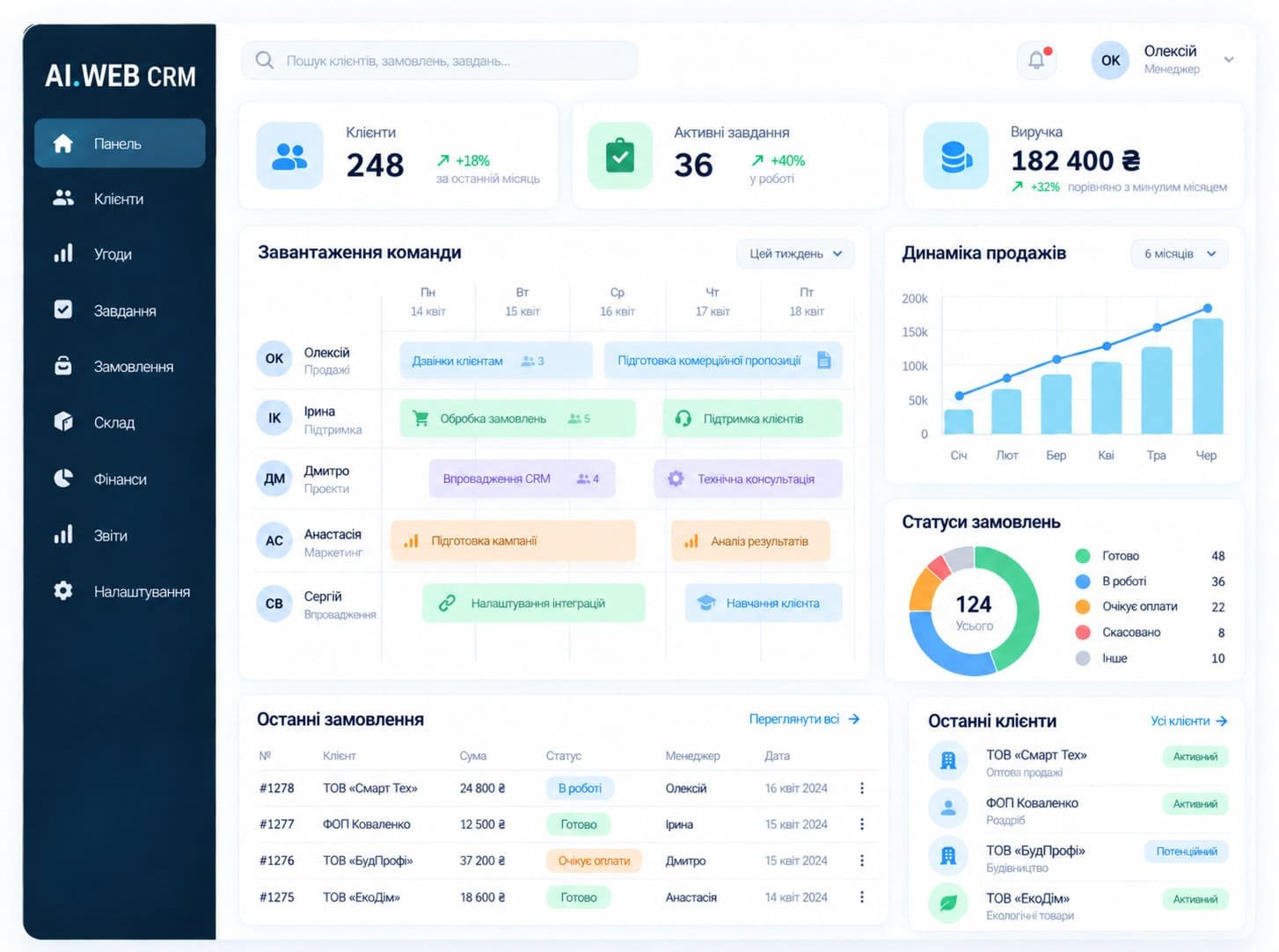
A CRM system becomes critical when the volume of clients, leads, or team members exceeds what spreadsheets can efficiently handle.
Initially, spreadsheets work fine.
Problems emerge when data duplicates, leads slip through cracks, follow-ups get forgotten, and management loses visibility into operations.
In this situation, a custom CRM solution often delivers more value than another marketing channel.
But you don't always need to build from scratch.
Start by exploring existing platforms. Custom development makes sense only when standard tools don't match your workflows or force you to change your processes to fit their limitations.
Automation works best for repetitive processes
Automation delivers results where you have consistent, repeatable tasks.
Think data transfers between systems, document generation, catalog updates, task creation, staff notifications, or status synchronization.
But automating chaotic processes is a mistake.
First, understand how work actually flows, identify waste, pinpoint errors, and define exactly what should happen automatically.
Otherwise, you'll just have the same inefficient process in a more complex technical form.
Set up analytics early
Without analytics, it's nearly impossible to know which changes actually moved the needle.
So establish at least basic tracking before scaling advertising, pursuing SEO, or overhauling your site.
You don't need sophisticated dashboards initially.
Start by understanding:
- where users come from;
- which pages they visit;
- what actions they take;
- where leads originate;
- whether you can connect marketing channels to actual results.
The sooner you start collecting clean data, the better decisions you'll make going forward.
A practical framework for prioritization
In most cases, straightforward logic guides the choice.
| Situation | Investigate first |
|---|---|
| Few inquiries coming in | Market demand, site quality, SEO potential, and advertising effectiveness |
| Good traffic, weak lead generation | Site quality, value proposition, user experience, and conversion optimization |
| Leads arrive but disappear | Lead management process and CRM systems |
| Too much manual work | Process efficiency and automation opportunities |
| Unclear what's producing results | Analytics setup and tracking |
| Over-reliance on one channel | Alternative lead generation channels |
| Outdated site limiting growth | Site modernization or rebuild |
This isn't a formula to follow blindly.
The core principle is simple: identify the problem first, then select the appropriate tool.
A real-world example
One of our clients ran their entire operation through Google Sheets for years. Orders, calculations, project stages, documents—everything lived in spreadsheets.
As transaction volume grew, this system became a bottleneck. Data had to be manually copied between sheets, team members struggled to track project status, and certain tasks took far longer than they should.
The challenge wasn't simply "replace spreadsheets with CRM."
We first mapped the entire workflow: how orders arrive, how estimates get prepared and versioned, what happens after approval, who receives tasks, how execution gets tracked, when invoices generate, and how payments get recorded.
Only then did we understand which steps belonged in the CRM and which operations could be simplified or automated.
The resulting system does far more than replace Google Sheets. It consolidates information in one place, reduces manual work, streamlines task handoffs between team members, provides real-time project visibility, and saves the team countless hours on repetitive work.
Management also benefits. Instead of cobbling together information from multiple sheets or asking staff for status updates, leadership sees a complete operational picture—all orders, all tasks, all project stages, and the current state of every process.
The real value wasn't the CRM itself, but the fact that analyzing their processes revealed ways to make work simpler, more manageable, and less dependent on constant human oversight.
This example illustrates that digital transformation isn't always about marketing. Sometimes the biggest business impact comes from streamlining internal operations.
You don't have to do everything sequentially
Once you understand the overall strategy, several initiatives can move forward in parallel.
For example, while building a new site, you can simultaneously conduct SEO analysis, plan information architecture, configure analytics, and prepare CRM integration.
But each task should have a clear purpose.
Parallel work is different from trying to do everything at once.
A simple decision-making framework
Before starting any digital initiative, answer these four questions:
- What problem are we solving?
- Why does this problem exist?
- What's the minimum solution that addresses it?
- How will we know if we've succeeded?
This approach prevents wasting budget on tools that don't yet address your core business challenge.
Sometimes the best first step is a new website. Sometimes it's advertising. Other times it's a CRM, analytics, or automation.
The goal isn't to find the "best digital tool," but to pinpoint what will create the most tangible business impact right now.