

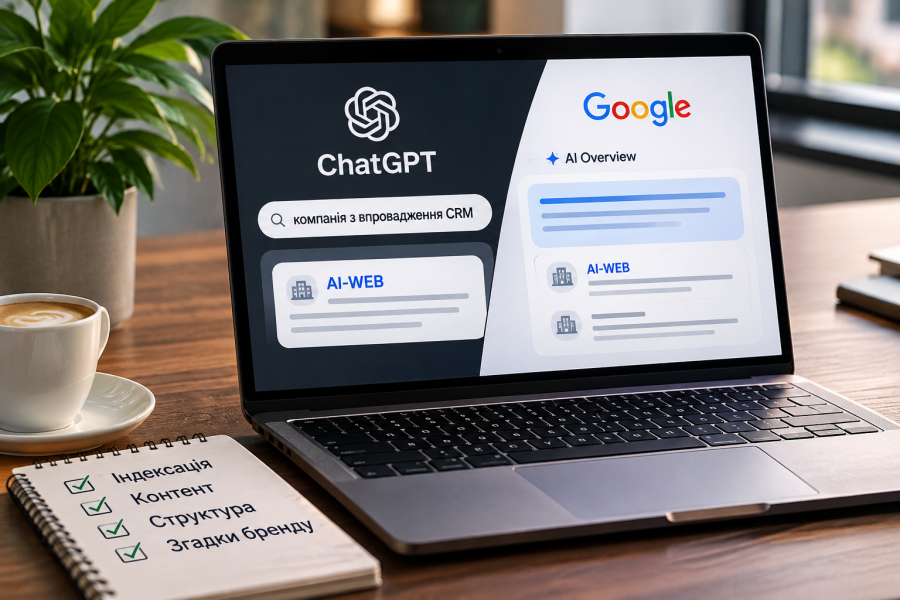

If ChatGPT, Google AI, or Microsoft Copilot don't mention your company in their responses, the issue isn't necessarily poor SEO. Most often, you should check three things: whether search engines can access your business information, whether your website clearly describes your services, and whether third-party sources verify your company's credibility.
Even a website ranking well in Google isn't guaranteed to appear in AI-generated answers. AI systems may choose different sources if they more directly address the user's specific question.
According to Google's official documentation, appearing in AI Overviews and AI Mode doesn't require special optimization beyond core SEO principles. However, your pages must be indexed and eligible to appear in search results.
Let's walk through how to assess your business visibility and identify what needs improvement.
How AI search discovers and selects companies
Traditional search typically presents users with a list of links. AI search can synthesize a complete answer, compare offerings from multiple companies, or recommend a specific service provider.
For example, a user asks:
«Which company can implement CRM for a service center in Kyiv?»
An AI system searches for companies that work with service centers, offer relevant solutions, and provide clear service descriptions.
Google confirms that AI Mode and AI Overviews can use query fan-out technology: running multiple related searches to gather information from different sources.
This means businesses need visibility not just for general searches like «CRM» but also for specific customer needs.

However, different AI systems use different search mechanisms and response generation methods. So ranking in Google doesn't automatically mean your company will be mentioned in ChatGPT.
1. Verify your site is being indexed
Start with technical accessibility of your pages.
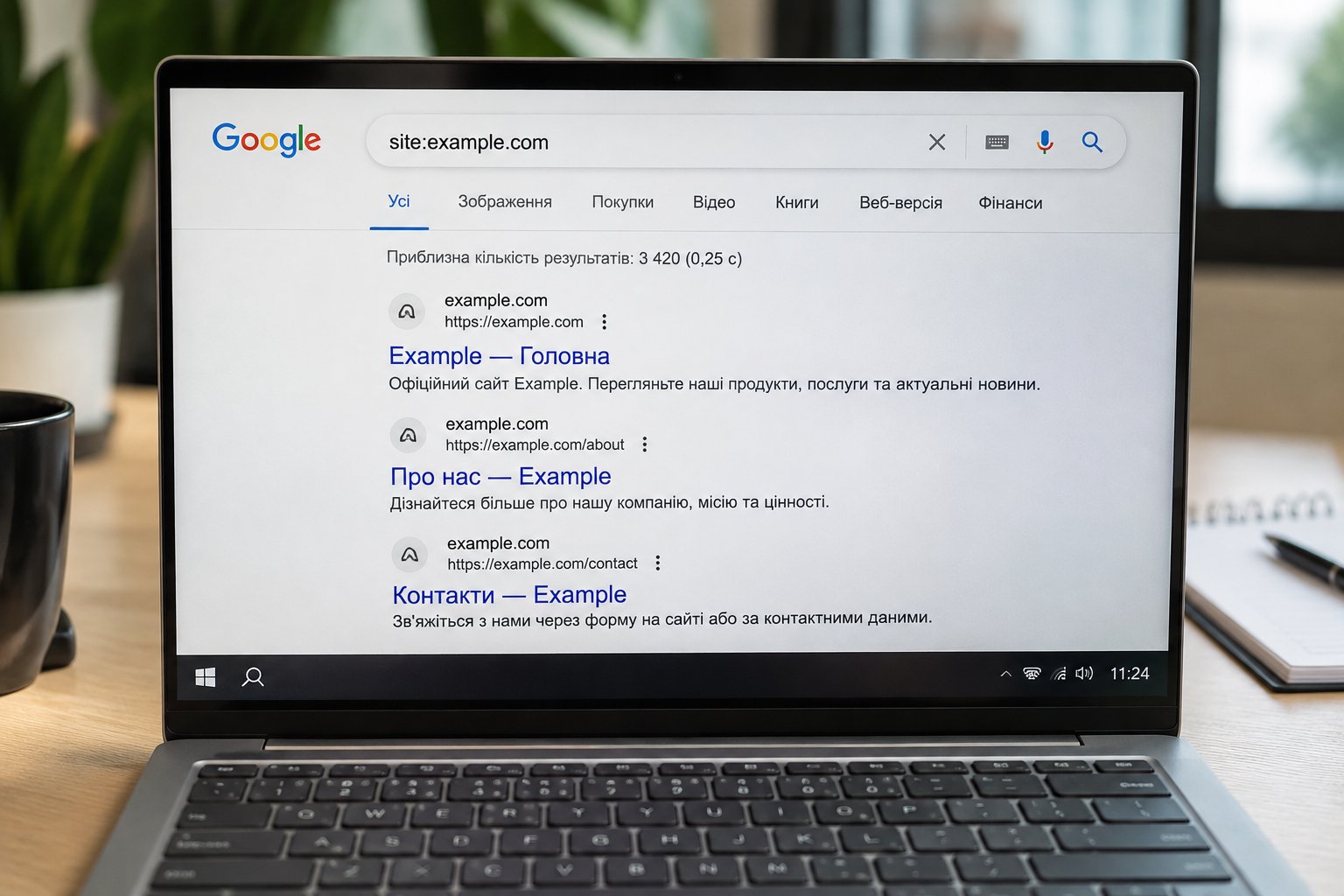
Open Google and type:
site:example.com
Replace example.com with your actual domain. This command shows some pages Google displays in search results, but it's not a precise count of all indexed URLs.
For more accurate verification, use Google Search Console.
Pay attention to your homepage, service sections, company information page, and contact page. If important URLs aren't indexed, investigate the cause using the URL inspection tool.
Common indexing barriers
- robots.txt. This file may block search bots from crawling important sections.
- noindex directive. This prevents pages from being added to the search index.
- Incorrect canonical tag. A page may point to a different URL as its primary version.
- Server errors. 403, 404, 5xx responses or bot protection mechanisms can prevent crawler access.
- Uncrawlable content. For example, important service descriptions load only after user interaction, and crawlers can't retrieve them.
Pay special attention to Cloudflare, WAF, and other bot protection settings.
Google recommends ensuring content accessibility at both the robots.txt level and at your hosting or CDN level.
Learn more: Google's technical requirements for AI search.
2. Check access for ChatGPT's crawler
OpenAI uses the OAI-SearchBot crawler to access website information.
This differs from GPTBot, which collects content potentially suitable for model training.
This distinction matters: site owners can separately control access for these bots.
Example robots.txt entry allowing OAI-SearchBot:
User-agent: OAI-SearchBot
Allow: /
This allows crawling but doesn't override other server restrictions. Verify that your site security doesn't block OpenAI's official bot IP addresses.
The complete bot guide and access management rules are in OpenAI's documentation.
Practical takeaway: If your crawler access is blocked, improving your content won't solve the problem. Technical accessibility comes first.
However, allowing crawler access doesn't guarantee ChatGPT will recommend your company. OpenAI explicitly states that search ranking doesn't guarantee inclusion in responses.
3. Ensure AI understands what your company does
A common problem with business websites is overly generic service descriptions.
For example, your homepage might say:
«We create innovative digital solutions for modern business.»
This is too vague to determine what you actually offer, who benefits, or what problems you solve.
Much better to be specific:
«We implement CRM systems for small and mid-market companies, customizing platforms for sales processes, customer management, and order fulfillment.»
The second version clearly explains your specialization.
What your service pages should include

Each main service needs its own clearly-written page covering:
- Which companies and industries benefit from this service.
- What specific business problems it solves.
- What's included in the work.
- What factors affect pricing and timelines.
- What limitations or conditions apply.
If you develop websites, describe not just design but also structure, mobile responsiveness, technical support, and other services you actually provide.
For CRM, explain whether you offer pre-built solutions with configuration or custom development from scratch. These are different approaches users need to understand.
These specifics help both regular visitors evaluate your offer and search systems understand your content better.
4. Check how your business appears elsewhere online
AI search may use sources beyond your official website.
So check how your business is represented across the internet.
Start by searching your brand name, domain, and key service terms combined with your location.
See if your company has current listings in professional directories, industry publications, partner websites, and other relevant sources.
Pay close attention to consistency. If one site shows an old company name, another has a different domain, and a third lists outdated services, users and search systems struggle to recognize it's the same business.
For local companies, Google Business Profile is critical. According to Google, local visibility depends on relevance, distance, and prominence. Complete, accurate business information helps Google assess your relevance.
Don't buy mentions in questionable directories. A few substantial features in relevant publications beats hundreds of low-quality listings.
5. Add clear organizational information
Your site should display company name, business description, contact information, service areas, and links to official profiles.
Additionally, use Schema.org structured data.
This special markup helps search systems understand organizational information in a standardized format.
Common types include:
Organizationfor company details.LocalBusinessfor location-based businesses.
For example, Organization markup can contain company name, logo, website, contact details, and official profile links via the sameAs property.
Google confirms that Organization structured data helps distinguish organizations in search results.
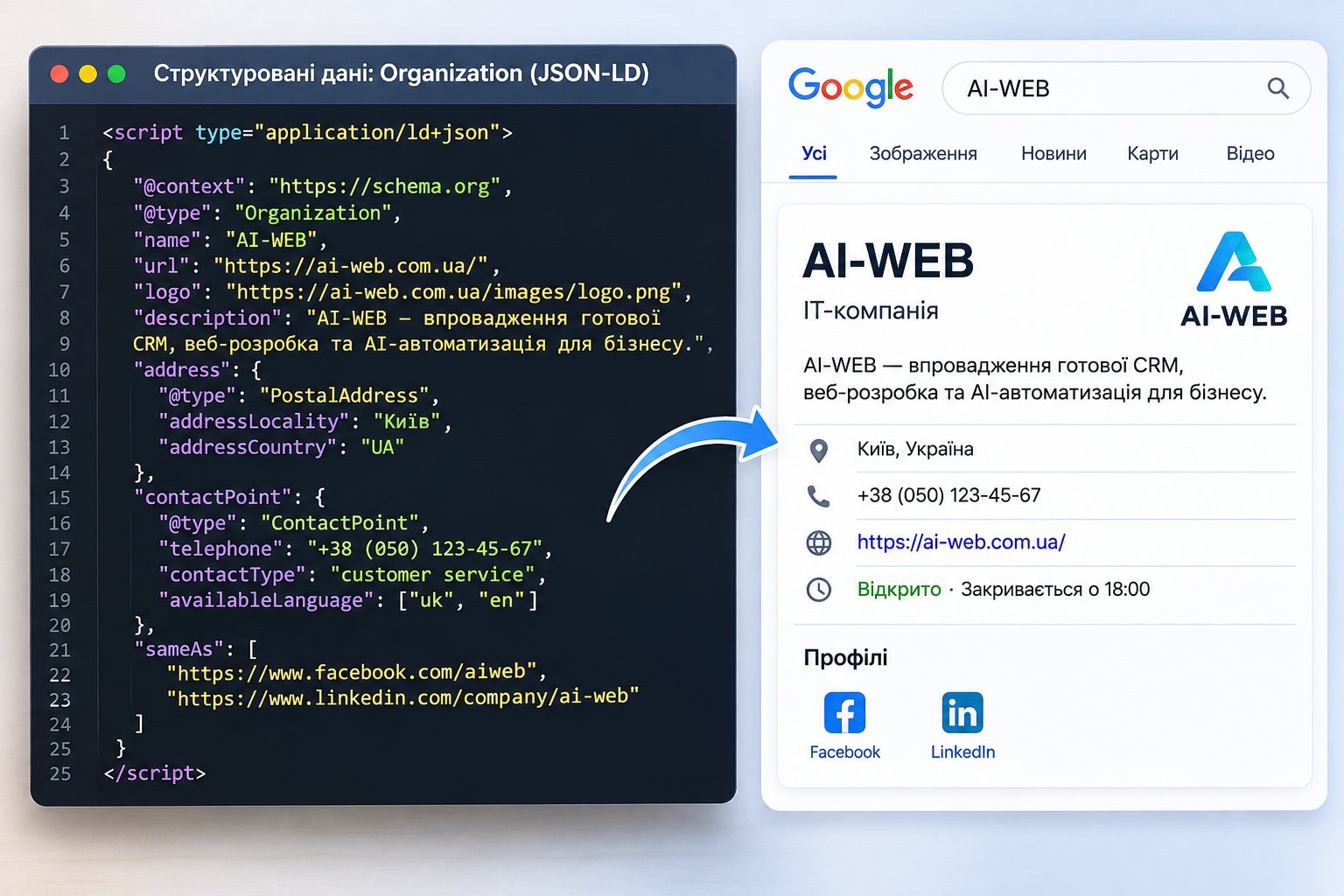
However, markup won't force inclusion in AI responses. Google separately notes that special Schema.org markup specifically for AI Overviews or AI Mode isn't required.
6. Create content for actual customer questions
AI search often handles comparisons, explanations of complex processes, and service selection.
So companies benefit from knowledge base content alongside commercial pages.
A CRM implementation agency might create articles on choosing CRM for service centers, migrating customer databases, organizing team workflows, or common sales automation mistakes.
A web development studio could cover site speed issues, maintenance costs, e-commerce launch preparation, or indexing problems.
Good content answers specific questions, explains limitations, and helps readers decide.
Key insight: Instead of dozens of shallow SEO articles, create a few that thoroughly address potential customer problems. This won't guarantee AI mentions, but it increases your site's real value.
Don't substitute expertise with auto-generated text without review. Bing's guidelines warn against mass-producing low-quality content and manipulating search systems.
7. How to check if AI already mentions your business
A single ChatGPT query isn't sufficient for reliable conclusions.
Responses depend on query wording, available sources, context, and each AI system's mechanisms.
For initial assessment, try this approach:
- Check brand recognition. Ask: «What do you know about [company name]? What services do they offer?»
- Check category. Search: «Which companies provide [service] in [city]?»
- Check specialization. Ask: «Who can help with [specific business problem]?»
- Compare systems. Run similar queries in ChatGPT with web search, Google AI, and Microsoft Copilot where available.
- Review sources. See which sites AI cites, whether it accurately describes your company, and if it mentions competitors.
Use identical wording, language, and region for comparison. Repeat testing across different days.
Document results in a table: date, system, query, brand mention, website link, information accuracy.
This becomes your own monitoring tool, not official statistics of all AI responses.
Tools that show real data
Google Search Console. Tracks indexation, search queries, and traffic. Per Google's documentation, AI Overviews and AI Mode data appear in overall search performance reports, not as separate AI mention statistics.
Bing Webmaster Tools. Features AI Performance reporting, showing your pages' citations in supported AI scenarios for Microsoft Copilot, Bing, and partner integrations. You can analyze cited URLs and related search terms.
Microsoft notes that AI Performance shows aggregated data, not individual user responses. Citation counts don't equal visits.
Information verified November 8, 2026.
8. What does improving AI search visibility cost
There's no separate mandatory fee for inclusion in organic AI responses. Main costs involve technical optimization, content, and brand development.
Budget depends on site size, indexation status, topic competition, service count, and page refinement needs.
For small business sites, start with an audit, then prioritize tasks.
| Task | Priority |
|---|---|
| Remove indexation blockers | Critical |
| Clarify main service descriptions | High |
| Fix company information | High |
| Build knowledge base | Medium |
| Regular AI mention monitoring | Ongoing |
As an example, a ten-page site could start by verifying indexation for all pages, refining three key commercial pages, and developing two resources answering customer questions.
This isn't a mandatory scope—just a phased approach preventing wasted budget on secondary tasks.
Without in-house expertise, combine technical review and content optimization into comprehensive search marketing.
Common AI search optimization mistakes
The most common mistake is hunting for a magic technical trick to force AI to recommend your company.
For example, some claim adding llms.txt is required for AI search. Google directly states that extra machine-readable files aren't needed for its AI features.
Also avoid:
- Guaranteeing brand mentions in ChatGPT.
- Creating hundreds of near-identical pages for similar queries.
- Publishing fake reviews, case studies, or ratings.
- Adding structured data that doesn't match actual page content.
- Judging results from a single test query.
Another mistake conflates citation with recommendation. AI might use your article as an information source without recommending your business as a service provider.
These are different outcomes requiring separate evaluation.
If your company still isn't mentioned
If indexation works, pages thoroughly describe services, and company information is available elsewhere online, missing mentions don't necessarily indicate a problem.
AI systems may select other companies based on query specificity, demonstrated expertise, geography, or response generation patterns.
In this case, research which sources appear in results for important commercial queries. Then identify missing information on your site and content that would better serve potential customers.
Bottom line: The goal isn't forcing AI to name your brand. Make your company discoverable, your specialization clear, and your service information credible and useful.
For small and mid-market businesses, start not with expensive AI optimization tools but with verifying site technical health, information accuracy, and quality main service pages.
These fundamentals support both traditional SEO and potential AI search visibility.